
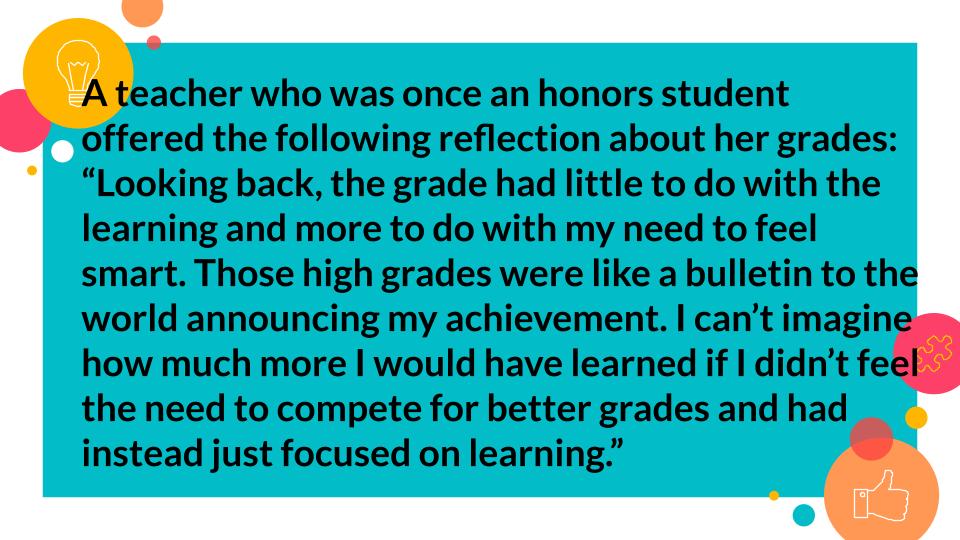
Once the gate to gradeless assessment was open, I couldn’t get through it fast enough. I immediately began planning how to introduce it to my students. Since New Year’s Day had just passed, that seemed like a logical exigence. “It’s a natural time for reflection,” I said. “So let’s reflect on our relationship to grades.” This was not the first time I had asked them to think about this topic, so they weren’t suspicious. I presented this quote that I found in Hacking Assessment:
Then I gave them some time to reflect on these questions:
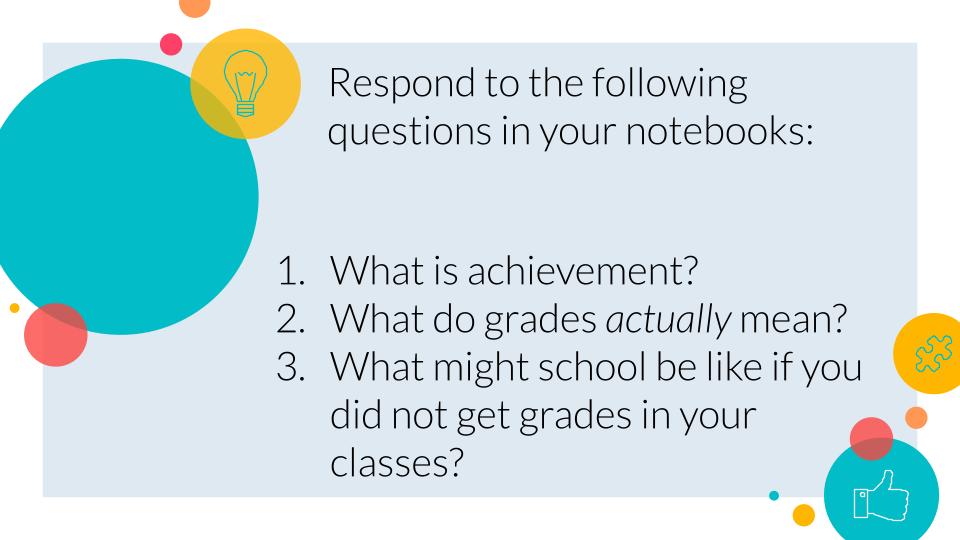
After about five minutes of writing, I asked for volunteers to share. Their responses were predictable; I had heard most of them before. Here is a sampling:
“I mean, it would be awesome. But I don’t know how it would work.”
“I don’t know if anyone would do any work if they weren’t getting grades.”
“Would we still have tests?”
After that last one, I tilted my head slightly, chin up, nonverbally communicating that I was deep in thought.
“No,” I said. I paused and let that sink in.
“Well then people definitely wouldn’t do work.”
But I could feel the energy in the room. Some of them—those who were already intrinsically motivated, those for whom grades always just got in the way—wanted a different answer. So I offered it to them.
“What do you say we try it?”
They looked at me. I clarified. “Let’s try not using grades.”
Jaws dropped. Literally. All of them.
I summarized my recent experiences reading about alternative assessment, ending with the fact that I had gotten permission not to enter numerical grades in the electronic gradebook.
“You’ll still get quarter grades,” I said. “We’ll just get to them in a different way.”
They had questions, of course. The biggest one also being the most obvious: “And what is that way?”
I did not have all the answers figured out. I wanted to answer some of these questions with them. So I said, “I’ve been doing some research, and we’re going to start with mastery based assessment. I haven’t figured anything else out yet, but I thought we could do that together. We’ll talk more about what that means over the next few days.”
They just looked at me. Some nodded. Some sat back in that skeptical teenage “You’re absolutely nuts, this will never work” posture.
“You have my word that I will not give you a quarter grade without your input.” I knew they trusted me.
“So what happens if someone asks for a higher grade than you think they should get?”
“Great question. It depends. What’s the evidence? But since this is clearly an experiment, and I want to make this work, I’ll probably just give you the grade you think you deserve, as long as it’s not completely unreasonable.”
A few more kids nodded.
“So what do you say? Should we try it?”
“Yeah, let’s do it.”
I nodded this time. “Cool,” I said.
I knew the road ahead would be long, winding, bumpy, potentially full of potholes (and this was before the first case of COVID had even been detected), but my heart was racing in excitement.
This was it. We were crossing the Rubicon. And I was never going back.
 Ms. Hastings